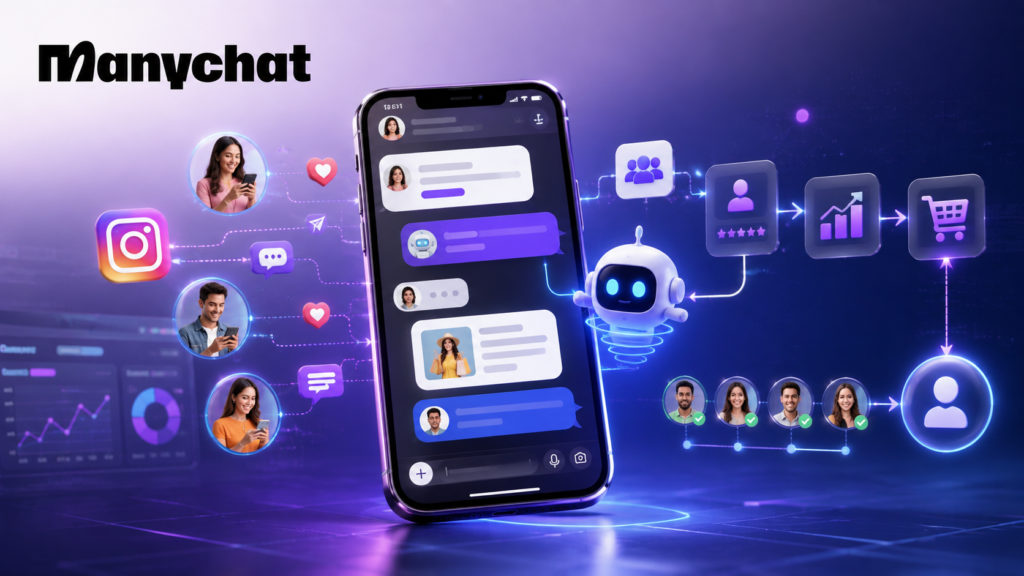
Manychat essentially connects customer actions with automated responses.
The process can be thought of as:
Customer action → Trigger → Automated conversation → Qualification → Conversion
For example:
Instagram Comment
↓
“Send me the details!”
↓
Manychat detects the keyword
↓
Automatic DM
↓
“Sure! Are you looking for the beginner or advanced guide?”
↓
Customer chooses an option
↓
Manychat sends the appropriate resource
↓
Lead is captured or customer is directed toward a purchase
The entire experience can happen without a salesperson manually replying to every person.
Manychat’s visual Flow Builder allows businesses to create these multi-step journeys using a drag-and-drop interface rather than requiring traditional programming.
Manychat is much more than an automatic “Thanks for your message” bot.
Here are some of its most useful applications.
1. Comment-to-DM Automation
This is arguably one of Manychat‘s most recognizable use cases.
A business can ask people to comment a specific word on an Instagram post.
For example:
“Comment PRICE and I’ll send you the details.”
Manychat can automatically start a private conversation with that person.
This turns public engagement into a private conversation—and potentially into a sales opportunity.
2. Lead Generation
Instead of sending every visitor to a traditional lead form, businesses can collect information directly through conversations.
A chatbot can ask questions such as:
“What service are you interested in?”
“What is your budget?”
“Would you like to book a consultation?”
The answers can then be used to segment and qualify leads.
3. Customer Support
Businesses receive many repetitive questions every day.
“What are your prices?”
“Do you ship to my city?”
“When will my order arrive?”
“How can I book?”
Manychat can automate responses to common questions and guide customers toward the information they need.
That doesn’t eliminate human support.
Instead, it allows humans to spend more time on conversations that actually require human judgment.
4. Sales Automation
Manychat can help move a customer through different stages of the buying journey.
For example:
Interested → Questions → Product recommendation → Offer → Purchase
Instead of treating every DM as a separate conversation, businesses can create structured customer journeys.
5. Audience Segmentation
Not every follower wants the same thing.
Someone looking for a beginner course should not necessarily receive the same message as someone ready to buy an advanced service.
Manychat allows businesses to collect information and organize audiences using tags and segmentation features available in its plans.
This makes automated communication more relevant.
6. WhatsApp Automation
WhatsApp is especially important for businesses that rely heavily on direct communication with customers.
Manychat supports WhatsApp automation through the WhatsApp Business Platform, allowing businesses to create automated customer journeys without coding.
That can be useful for:
- Lead qualification
- Customer questions
- Follow-ups
- Promotions
- Booking flows
- Sales conversations
7. Multi-Channel Marketing
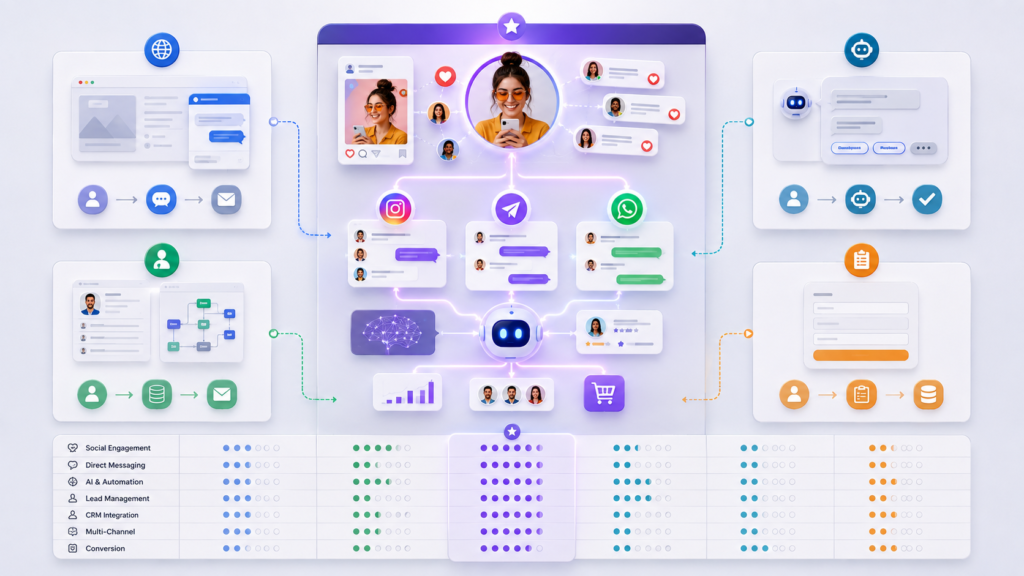
One of Manychat’s biggest advantages is that it isn’t limited to a single communication channel.
Depending on the plan, businesses can connect channels including Instagram, TikTok, Facebook Messenger, WhatsApp, Telegram, SMS and Email.
This matters because customers don’t all communicate in the same place.
A creator may primarily use Instagram.
A local business may depend heavily on WhatsApp.
A growing company may need several channels simultaneously.
Manychat gives businesses the ability to build automation around those different touchpoints.
Calling any software platform “the best” depends on the use case.
And Manychat isn’t automatically the best tool for every business.
For example, some competitors focus more heavily on customer support, unified team inboxes, Instagram-only automation, or broader CRM functionality. Manychat itself acknowledges that different alternatives can be better suited to particular needs.
However, Manychat stands out in several important areas.
1. Strong Social-Media Focus
Manychat was built around social conversations rather than simply adding a chatbot to a website.
That makes it particularly attractive to creators, influencers, agencies, ecommerce brands and businesses that generate leads through social media.
2. Powerful Automation Without Coding
The visual Flow Builder makes it possible to create complex conversational journeys without writing traditional code.
That lowers the technical barrier considerably.
3. Comment-to-DM Is Extremely Useful
For social-media marketers, turning comments into private conversations can be incredibly valuable.
Instead of hoping a follower clicks a bio link, a business can initiate a relevant conversation immediately after engagement.
4. Multi-Channel Capability
Manychat can extend beyond Instagram.
Depending on the plan, businesses can connect multiple supported channels and manage automated conversations across them.
5. Integrations
Marketing automation becomes much more useful when it can communicate with the rest of your business stack.
Manychat supports integrations with tools such as Shopify, HubSpot, Klaviyo, Google Sheets and Zapier.
That means a conversation doesn’t necessarily have to end inside the chatbot.
It can become part of a larger marketing or sales workflow.




 The Bigger Picture
 Final Verdict